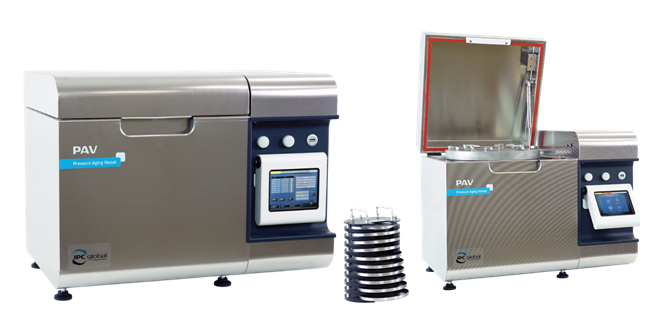
The Pressure Aging Vessel (PAV) is a specialized instrument designed to simulate the long-term oxidative aging of asphalt binders over a 5 to 10-year service life. This essential process follows the initial short-term aging of the RTFOT and is a core requirement for Superpave performance-based testing.
Key Performance Features
Intelligent Touch-Screen Control: Equipped with a 6″ color reclinable touch-screen, allowing operators to monitor vessel pressure and temperature in real-time via live graphs and data readouts.
Rapid & Uniform Heating: Features highly efficient encased band heaters and PID temperature control that reaches the set point in less than one hour, exceeding international standard requirements.
Programmable Pre-Heating: Includes a safety-limited pre-heating function (up to 60°C) to ensure the vessel is ready for testing immediately upon sample loading while protecting the operator.
Safety-Centric Design: * Electronic Top Cover Lock: Prevents the lid from being opened while the vessel is pressurized or during the active test cycle.
Forced Ventilation Cooling: A built-in system that quickly cools the sample rack after the test to prevent accidental burns.
Over-Pressure & Over-Temp Protection: Integrated mechanical relief valves and software-driven cut-offs ensure total lab safety.
Compliance & Standards
ASTM D6521: Standard practice for accelerated aging of asphalt binder using pressurized air.
AASHTO R28: The American Association standard for pressurized aging of asphalt binder.
EN 14769: European standard for accelerated oxidative aging of bituminous binders.
Data Traceability: Test data (temperature and pressure logs) are saved directly to a USB stick or can be transferred to a PC for official reporting.
System Integration
To meet mandatory laboratory requirements, the PAV is typically paired with the Vacuum Degassing Oven (VDO). This removes air bubbles from the aged binder, making the sample ready for further testing in a Bending Beam Rheometer (BBR) or Dynamic Shear Rheometer (DSR).